Some links on this page are affiliate links. If you buy through them we may earn a commission at no extra cost to you. How we make money.
The Rabbitgoo Cat Harness and Leash Set is our top pick for most owners, because it bundles an adjustable harness with a leash at an approachable price. If your cat wriggles out of everything, look at a vest-style option like the Kitty Holster first.
Key takeaways
- Fit matters more than brand: a snug, correctly sized harness is what prevents escapes.
- Vest-style harnesses are often the best bet for cats that slip out of simple strap designs.
- Use a lightweight leash of about four to six feet, and avoid retractable leashes for cats.
- Introduce the harness indoors over days or weeks before any outdoor trip.
- Check vaccinations, parasite prevention and microchipping with your veterinarian before starting walks.
- Stop if your cat shows stress, and treat breathing trouble or collapse as an emergency.
A cat harness is not a fashion accessory. It is the only thing standing between a startled cat and a busy road, so the design matters far more than the color. Cats can compress their shoulders and back out of a loose strap in seconds, which is why a typical dog harness often fails on them.
This guide is based on research, not hands-on testing. We compared well-known harness and leash sets on the criteria that matter most for cats: escape resistance, adjustability, comfort around the neck and chest, secure closures, leash weight and length, and how easy each one is to put on a nervous animal. We also weighed how forgiving each design is for beginners.
Below you will find five widely available options, a buying guide, a list of common mistakes, and a practical training plan. Fit and patience will do more for your cat's safety than any single product.
Our top picks at a glance
| # | Product | Why we like it | |
|---|---|---|---|
| 1 | Rabbitgoo Cat Harness and Leash Set Best Overall | This set pairs an adjustable, lightweight harness with a matching leash, which makes it an easy starting point for first-time walkers. | View |
| 2 | PetSafe Come With Me Kitty Harness and Bungee Leash Best Bungee Leash Set | PetSafe is a familiar pet-gear brand, and this set pairs a cat-specific harness with a bungee leash. | View |
| 3 | Kitty Holster Cat Harness Best Vest Style | The Kitty Holster is a vest-style harness that spreads pressure across the torso instead of relying on thin straps. | View |
| 4 | Mynwood Cat Harness Best for Escape Artists | Mynwood designs its cat harnesses with escape resistance in mind, using a wrap-around, vest-like cut with adjustable closures. | View |
| 5 | Gooby Escape Free Sport Harness Best Step-In Style | Gooby's step-in harness is built so your cat steps into the openings and you fasten it over the back, with no pulling anything over the head. | View |
Product reviews
Rabbitgoo Cat Harness and Leash Set
Best OverallThis set pairs an adjustable, lightweight harness with a matching leash, which makes it an easy starting point for first-time walkers. The multiple adjustment points let you fine-tune the fit around the neck and chest, and the design is meant to resist backing out when sized correctly. Because it is a complete bundle, you do not have to match separate pieces yourself. It suits cats who are curious and relaxed, and it is a sensible choice if you are not sure which style your cat will tolerate.
PROS
- Harness and leash come together as one set
- Several adjustment points for a closer fit
- Lightweight feel suits beginners
CONS
- Strap-style designs still need careful fitting to prevent escapes
- Included leash is a basic fixed length rather than a bungee
PetSafe Come With Me Kitty Harness and Bungee Leash
Best Bungee Leash SetPetSafe is a familiar pet-gear brand, and this set pairs a cat-specific harness with a bungee leash. The stretchy leash helps absorb sudden lunges or pulls, which is useful for cats that bolt then freeze. The harness is built around the shape of a cat rather than a scaled-down dog design. It works well for cats who startle easily and for owners who want a little give in the line. Check the brand's size chart carefully before ordering, since cats vary widely in build.
PROS
- Bungee leash cushions sudden pulls
- Cat-specific harness design
- Recognizable brand with easy-to-find sizing guidance
CONS
- Bungee stretch can make close control harder in crowded places
- Sizing needs careful measuring for very small or very large cats
Kitty Holster Cat Harness
Best Vest StyleThe Kitty Holster is a vest-style harness that spreads pressure across the torso instead of relying on thin straps. Many owners of escape-prone cats look at this style first because the wider body panel leaves less room to wriggle free. It tends to feel more like a snug garment than a set of straps, which some cats accept more readily. Sold as a harness, so you will want to pair it with a separate lightweight leash. Measure your cat carefully, as vest fit is more size-specific.
PROS
- Vest design distributes pressure more broadly
- Often favored for cats that slip out of strap harnesses
- Snug garment feel can calm some cats
CONS
- Leash is usually purchased separately
- Can feel warm in hot weather and needs precise sizing
Mynwood Cat Harness
Best for Escape ArtistsMynwood designs its cat harnesses with escape resistance in mind, using a wrap-around, vest-like cut with adjustable closures. This is a smart consideration for cats who have already shown they can back out of simpler designs. Padding and a more structured body help keep the harness stable while your cat moves. As with any harness, a snug and correct fit is what truly prevents escapes. Look at the current listing for the included leash and available sizes, since bundles and options can change.
PROS
- Structured, vest-like cut aimed at secure fit
- Adjustable closures for fine-tuning
- Good option for cats with a history of slipping out
CONS
- More straps and parts mean it takes longer to put on
- Requires patience to introduce to a sensitive cat
Gooby Escape Free Sport Harness
Best Step-In StyleGooby's step-in harness is built so your cat steps into the openings and you fasten it over the back, with no pulling anything over the head. That can help with cats who hate being handled around the face. The soft, simple design is easy to put on and take off, which makes training sessions less stressful. It is sold for small dogs and cats, so check the sizing chart closely and confirm a snug chest fit before leaving the house.
PROS
- Step-in design avoids pulling over the head
- Quick on and off for short training sessions
- Simple, soft construction
CONS
- Marketed for both small dogs and cats, so fit needs close checking
- Less padded than some vest-style options
How to choose a cat harness and leash set
Start with fit, not style
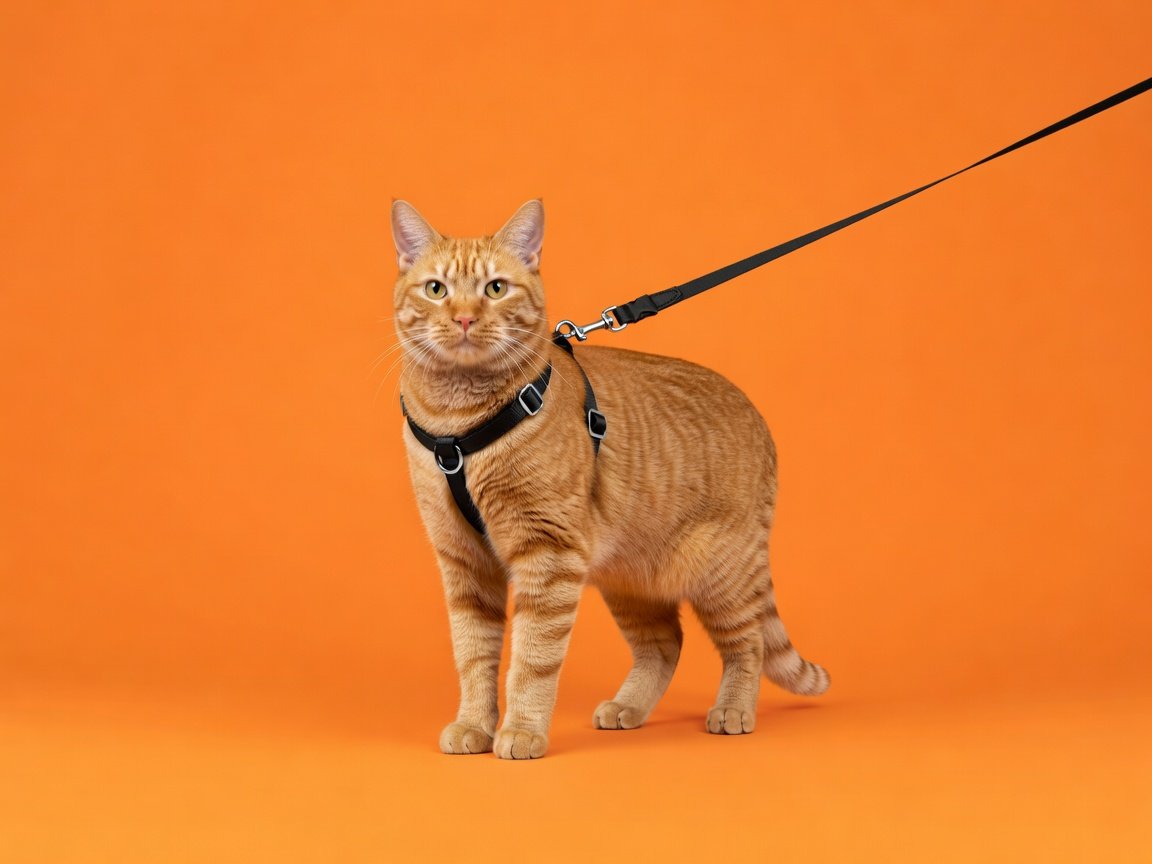
A cat harness must be snug enough that your cat cannot back out, yet loose enough to breathe and move freely. A common rule of thumb is that you can slide two fingers under any strap, but not much more. Measure neck and chest girth with a soft tape before checking any size chart, and remeasure kittens often because they outgrow gear quickly.
The three main designs
- Vest style: A wider fabric panel covers the torso and spreads pressure. It is often the most escape-resistant, but it can run warm and needs accurate sizing.
- H-style or strap harnesses: Two loops joined by a strap along the back. They are light and breathable, though a poor fit makes them easier to slip.
- Step-in styles: Your cat steps into the openings and you fasten it over the back. They suit cats that dislike things going over their heads.
Materials and hardware
Look for soft, flexible webbing or padded fabric that will not rub behind the front legs, where chafing often starts. Check that buckles and clips feel solid and are easy for you to operate but hard for a cat to paw open. Avoid heavy metal hardware on small cats.
Features worth having
- Multiple adjustment points for neck and chest
- Reflective trim if you walk near dusk
- A lightweight leash that will not drag on your cat
- A secure leash attachment point on the back
Sets versus separate pieces
A bundled set saves guesswork and is ideal for beginners. Buying separately gives you more control, for example pairing a vest-style harness with a bungee leash. Either way, the harness is the safety-critical piece, so spend your attention there first.
Leash length and type: what really works for walking cats
How long should a cat leash be?
Most owners do well with a leash somewhere around four to six feet. That gives your cat room to sniff and explore while letting you reel them in quickly. Very long leashes and retractable leashes make it hard to react if a dog, car or loud noise appears.
Fixed, bungee or retractable?
- Fixed leash: Predictable and easy to control. Best for crowded or unfamiliar spaces and for training.
- Bungee leash: A built-in stretch absorbs sudden lunges, which can reduce the jolt on a cat that bolts. The trade-off is slightly less precise control.
- Retractable leash: Generally not recommended for cats. The handle is bulky, the cord can snap tight without warning, and a sudden lock can startle or injure a cat.
Weight and handle comfort
Cats notice weight on their backs. A thin, lightweight leash is usually best, and a heavy clip can annoy a small cat. A comfortable handle or a loop that you can wrap around your wrist helps you keep a firm hold without gripping hard.
Let your cat lead
Unlike dogs, cats rarely walk in a straight line beside you. The goal is a shared stroll, with your cat choosing direction while you keep gentle slack in the line. Avoid tugging or dragging. If your cat freezes or flattens against the ground, wait or pick them up and move to a calmer spot.
Pair the leash with a secure setup
Clip the leash only to the harness attachment point, never to a collar. A collar alone can injure the neck if your cat bolts. Check the clip each time, and consider holding the leash in both hands in new places until your cat is relaxed.
Common cat harness mistakes to avoid
Using a harness that is too loose
This is the most common and most dangerous error. A loose harness lets a frightened cat twist and back out, often in a heartbeat. After fastening, gently tug the leash to see whether the harness rotates or lifts over the shoulders, and tighten if needed.
Going outside too soon
Many cats are overwhelmed if the first time they wear a harness is also their first time outdoors. Spend days or weeks indoors with the harness first, so the sensation feels ordinary before you add traffic, smells and sounds.
Skipping preventive care
Outdoor time exposes cats to fleas, ticks and contagious illness. Talk to your veterinarian about vaccinations, parasite prevention and microchipping before you start walks. A microchip and ID tag give you a backup if your cat ever gets loose.
Picking the wrong location
Busy streets, off-leash dogs and loud areas are poor choices. A quiet yard, a calm garden or a low-traffic path is a better start. Always check for hot surfaces: asphalt and pavement can burn paws in warm weather.
Leaving the harness on unsupervised
A harness is for supervised walks only. A cat left wearing one can snag it on furniture or become tangled. Take it off when the outing ends.
Forcing the issue
Pushing a reluctant cat into a harness or dragging them along teaches them to fear it. Stop when your cat shows stress, such as flattened ears, a lashing tail or frantic struggling. Some cats simply prefer not to walk, and that is fine.
When to call the vet
If your cat shows breathing difficulty, repeated vomiting, or collapse after an outing, treat it as an emergency and contact a veterinarian right away. For skin irritation from rubbing, ask your vet for advice.
How to train your cat to walk in a harness
Step 1: Let your cat investigate
Leave the harness near your cat's bed or feeding area for a few days. Let them sniff it. Offer treats near it so it becomes linked with good things.
Step 2: Touch and drape
Once your cat is comfortable, gently rest the harness over their back for a few seconds, then reward. Repeat over several short sessions. Do not fasten anything yet.
Step 3: Fasten briefly
Fasten the harness, check the fit, give a treat or favorite food, then remove it. Keep early sessions to a minute or two. Gradually lengthen the time as your cat stays relaxed. Some cats freeze when first wearing one, which is normal. Wait it out calmly and reward movement.
Step 4: Add the leash indoors
Clip on a lightweight leash and let it trail while your cat moves around in a safe room under supervision. Then pick up the handle and follow your cat with slack in the line. Never pull.
Step 5: Try a safe outdoor spot
Carry your cat to a quiet, enclosed area at first, such as a fenced garden. Set them down and let them explore at their own pace. Keep sessions short and end on a positive note.
Step 6: Build gradually
Increase time and distance as confidence grows. Many cats prefer sitting and watching to walking far, and that still counts as enrichment.
Reading your cat
Dilated pupils, crouching low, panting or trying to hide mean it is time to go home. Kittens often adapt faster, but older cats can learn too if you go slowly. If your cat resists after consistent, gentle training, consider a catio or window perch instead.
Frequently asked questions
Is it safe to walk a cat on a harness and leash?
It can be safe when the harness fits snugly, your cat is trained to it, and you choose quiet places. Talk to your veterinarian first about vaccinations, parasite prevention and microchipping, since outdoor exposure brings health risks that indoor life does not.
Can I use a dog harness on my cat?
Usually it is not ideal. Cats can compress their shoulders and slip out of designs made for dogs. A cat-specific harness, especially a vest or well-fitted adjustable style, is generally a safer choice. Some small-dog harnesses do work if they fit snugly, but check carefully.
How tight should a cat harness be?
Snug but comfortable. You should be able to fit about two fingers under the straps, but the harness should not twist or lift over the shoulders when you gently tug the leash. Recheck the fit every outing, especially on growing kittens.
What age can a kitten start wearing a harness?
Many kittens can begin short indoor harness introductions at a young age, but outdoor trips should wait until your veterinarian confirms vaccinations and parasite protection are in place. Kittens grow fast, so check fit often and adjust or replace the harness.
What if my cat just lies down and refuses to walk?
This is common and usually means the harness feels strange or the setting is overwhelming. Go back a step, reward calm behavior indoors, and keep sessions short. Never drag your cat. Some cats prefer sitting outside and watching rather than walking.